
Under international SHENG 4 call for Polish and Chinese research projects, funding will be awarded to 21 projects with a value of over PLN 38 million.
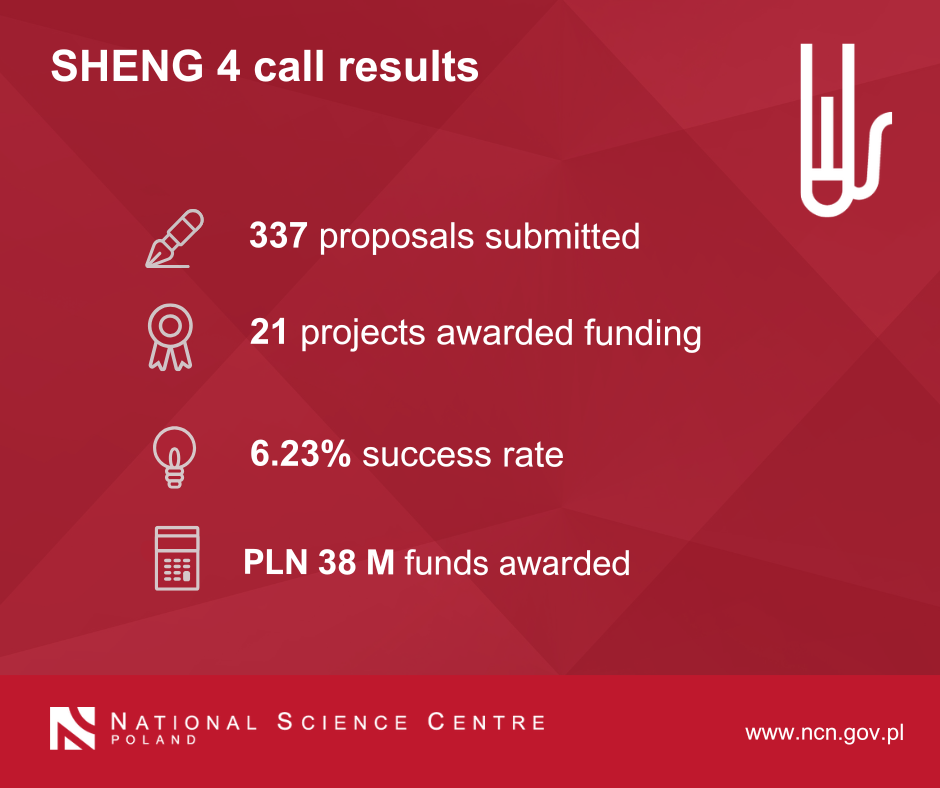 Under SHENG 4 that has just been concluded, researchers could submit proposals to selected disciplines within three research domains. Out of 337 proposals, 229 were submitted to Physical Sciences and Engineering, 103 to Life Sciences, and only 5 to Humanities, Social Sciences and Art Sciences. Nearly PLN 22.5 million was awarded to 13 projects in Physical Sciences and Engineering and nearly PLN 16 million to 8 projects in Life Sciences. The success rate was 6.23%.
Polypeptides in Osteoarthritis Treatment
One of the awarded projects in Life Sciences, titled “Synthesis and Functionalization of Hyperbranched Polypeptides for Osteoarthritis Treatment”, will be headed by Dr hab. Monika Gosecka from the Centre of Molecular and Macromolecular Studies, Polish Academy of Sciences. Osteoarthritis is a disease mainly affecting the elderly that involves pain, stiffness and restricted movement. Currently, treatment usually involves anti-inflammatory drugs or joint replacement, which are known for their side effects and inability to regenerate joint cartilage. In healthy joints, cartilage is well hydrated, which results in an extremely low coefficient of friction, but is degenerated and damaged as the disease progresses. Hyaluronic acid injections, which are widely used today, have limited efficacy and require frequent injections. The aim of the project is to develop new formulations for delivery injections using hyperbranched polypeptides, the structure of which will make them durable and will provide excellent lubrication of the joint, easy application and drug delivery. To this end, a library of polypeptides with different structures will be synthesised and studied, and knowledge gained in this project will show the relationship between the structural features of these molecules and their biological activity, leading to a development of more effective methods in the treatment of osteoarthritis.
From Natural Grasslands to Agricultural Sustainability
One of the projects awarded in Life Science will be carried out by Dr inż. Piotr Niezgoda from the West Pomeranian University of Technology in Szczecin, who will study biodiversity and functionality of arbuscular mycorrhizal (AM) fungi. In the face of continuous population growth and climate change, sustainable agriculture is becoming increasingly important, with its limited use of chemical fertilizers and pesticides that are replaced by microorganisms. Such microorganisms include arbuscular mycorrhizal (AM) fungi, which live in symbiosis with most terrestrial plants. They improve plant productivity and nutrition, and alleviate the effects of stress. Despite their importance for the ecosystems and agricultural potential, little is known of the diversity of AM fungi in the world, their activity, response to climate change and the possibilities of using them in practice. The project “Arbuscular Mycorrhizal Fungal Biodiversity and Functionality” aims to fill the void by comprehensive studies of AM fungal communities in croplands and grasslands located in China and Poland that differ greatly in terms of climate and soil properties. Modern techniques will be used, such as amplicon sequencing, phylogenies, reconstruction, isolation of single spores, and mycorrhizal functional tests, to characterize the structure and function of AM fungal communities, reveal the mechanisms underlying agricultural impacts on AM fungal symbiotic functions, and explore their response to environmental factors. The results will enhance our understanding of AMF ecology and evolution, support biodiversity conservation, facilitate their agricultural application, and contribute to the classification of new species, e.g. under transcontinental AM fungal resource bank. The project continues former joint research that resulted in the description of new AMF species in 2022.
List of Projects Recommended for Funding under SHENG 4
SHENG
SHENG 4 is the international bilateral Polish-Chinese Funding Initiative organised by the National Science Centre in cooperation with the National Natural Science Foundation of China (NSFC) pursuant to the parallel evaluation procedure, which means that both agencies perform a parallel eligibility check and merit-based evaluation and funding is awarded to projects recommended by both agencies. SHENG 4 was open to basic research proposals submitted to one of the following panes: HS6_01-HS6_08, HS6_14-HS6_15, ST4, ST5, ST8 and ST11, or NZ1-NZ9.
The winning projects will be performed in Poland and China, and each project will be supervised by two principal investigators, one for the Chinese research team and one for the Polish team. The Polish research team may use the awarded funds for research, remuneration of the research team, scholarships for students and PhD students, purchase or manufacturing of research equipment or other cost crucial to the Polish part of the project.