Principal Investigator
:
dr Grigor Sargsyan, prof. IM PAN
Institute of Mathematics of the Polish Academy of Sciences
Panel: ST1
Funding scheme
: MAESTRO 15
announced on
15 June 2023
The concept of infinity is ubiquitous in mathematics. However, since the ancient times it has been the source of many paradoxes. Zeno of Elea famously asked how a faster runner can always catch a slower one. Leibnitz and others, not knowing how to add up infinitely many numbers, thought that 1-1+1-1+1+...+1-1+...=1/2. Russel wondered how set of all sets can be a set, and Cantor wondered how many numbers there can be. The later is known as the Continuum Hypothesis, and it postulates that the cardinality - the size - of the set of all numbers is equal to the first infinite cardinality that is bigger than the cardinality of the set of all natural numbers, numbers such as 1, 2, 3, and etc. The Continuum Hypothesis was the first problem on Hilbert’s list of 23 mathematical problems that he presented in 1900 in Paris, during the International Congress of Mathematicians.
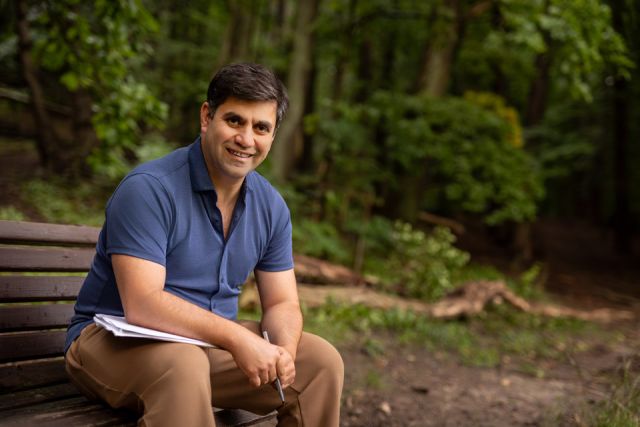
 dr Grigor Sargsyan, prof. IM PAN, photo Łukasz Bera
Unlike other paradoxes that have been resolved by fixing definitions and adopting proper axioms, the Continuum Hypothesis has been a persistent mystery. It is naturally a problem for set theorists, who study the mathematical properties of infinite sets, and who have developed a basic axiomatic system known as the Zermelo-Fraenkel Set Theory with the Axiom of Choice (ZFC for short) that can be thought of as simple grammatical rules for using infinite sets. The overwhelming expectation is that these rules do not lead to paradoxes and confusions.
dr Grigor Sargsyan, prof. IM PAN, photo Łukasz Bera
Unlike other paradoxes that have been resolved by fixing definitions and adopting proper axioms, the Continuum Hypothesis has been a persistent mystery. It is naturally a problem for set theorists, who study the mathematical properties of infinite sets, and who have developed a basic axiomatic system known as the Zermelo-Fraenkel Set Theory with the Axiom of Choice (ZFC for short) that can be thought of as simple grammatical rules for using infinite sets. The overwhelming expectation is that these rules do not lead to paradoxes and confusions.
While ZFC has been phenomenal in clearing set theory of simple paradoxes concerning infinity, the situation with the Continuum Hypothesis is that ZFC neither proves nor disproves the Continuum Hypothesis, as demonstrated by Gödel and Cohen. In 1966, Cohen received the Field’s Medal, the equivalent of Nobel Prize in mathematics, for this work. Thus, the axioms of ZFC do not completely describe the mathematical infinity, and very simple questions like the Continuum Hypothesis, are left open.
 dr Grigor Sargsyan, prof. IM PAN, photo Łukasz Bera
Since Cohen’s major breakthrough, set theorists have discovered several other axioms of infinity that answer the Continuum Hypothesis. The two of the most prominent ones are the determinacy axioms and the forcing axioms. Unfortunately, these two views lead to opposite answers to the Continuum Hypothesis. The first implies that the Continuum Hypothesis is true, while the second implies that the Continuum Hypothesis is false. Interestingly, the determinacy axioms tend to give a sense of determinism, in the sense that viewing the mathematical universe of sets as an ever expanding universe where the members of the sets higher up consist of objects that appear earlier on, every set is constructed via infinitary algorithms that are applied to smaller sets. The forcing axioms, on the other hand, tend to give a sense of randomness because they imply the existence of generic objects that saturate the universe with random information and whose existence cannot be predicted by examining the sets living in lower parts of the universe.
dr Grigor Sargsyan, prof. IM PAN, photo Łukasz Bera
Since Cohen’s major breakthrough, set theorists have discovered several other axioms of infinity that answer the Continuum Hypothesis. The two of the most prominent ones are the determinacy axioms and the forcing axioms. Unfortunately, these two views lead to opposite answers to the Continuum Hypothesis. The first implies that the Continuum Hypothesis is true, while the second implies that the Continuum Hypothesis is false. Interestingly, the determinacy axioms tend to give a sense of determinism, in the sense that viewing the mathematical universe of sets as an ever expanding universe where the members of the sets higher up consist of objects that appear earlier on, every set is constructed via infinitary algorithms that are applied to smaller sets. The forcing axioms, on the other hand, tend to give a sense of randomness because they imply the existence of generic objects that saturate the universe with random information and whose existence cannot be predicted by examining the sets living in lower parts of the universe.
Thus, while determinacy axioms and forcing axioms decide the Continuum Hypothesis, they are logically incompatible theories. The main objective of the project is to unify these two approaches to infinity and create bridges between them. The main idea used to unify the two theories is that each theory can naturally interpret the other, demonstrating that while the theories may differ in their grammatical rules, ultimately they describe the same mathematical reality. Recently, with my colleagues, I have introduced a new type of models called Nairian Models that play the role of the bridge between forcing axiom and determinacy axioms. It is expected that further investigations of these models will unravel more mysteries of the set theoretic universe leading to a more complete and unified picture of the mathematical infinity, and I am very grateful for the generous support from NCN that allows me to concentrate on the development of Nairian Models.
Project title: Forcing axioms, inner models and determinacy
dr Grigor Sargsyan, prof. IM PAN
Grigor Sargsyan obtained his PhD in 2009 from the University of California in Berkeley. He then moved to UCLA as a Postdoctoral Fellow of the National Science Foundation, and in 2012, moved to Rutgers University as an Assistant Professor where he later was promoted to tenured Associate Professor. In 2021, he won a competition for the position of Professor of IMPAN at the Gdansk Branch of IMPAN, he was habilitated in 2024, and in 2025, he moved to the Warsaw branch of IMPAN. His PhD thesis won the Sacks Prize of the Association of Symbolic Logic. Sargsyan is the recipient of several grants, including the NSF's Career Award and NCN's Maestro Grant.