
Maciej Stolarski, Łucja Kowalewska and Bartosz Szyszko will deliver open lectures organised by the Copernicus Centre on 26 November, 10 December and 17 December 2025. Lectures will be available on the YouTube channel of the Copernicus Centre and on the ‘Science at the Centre’ playlist.
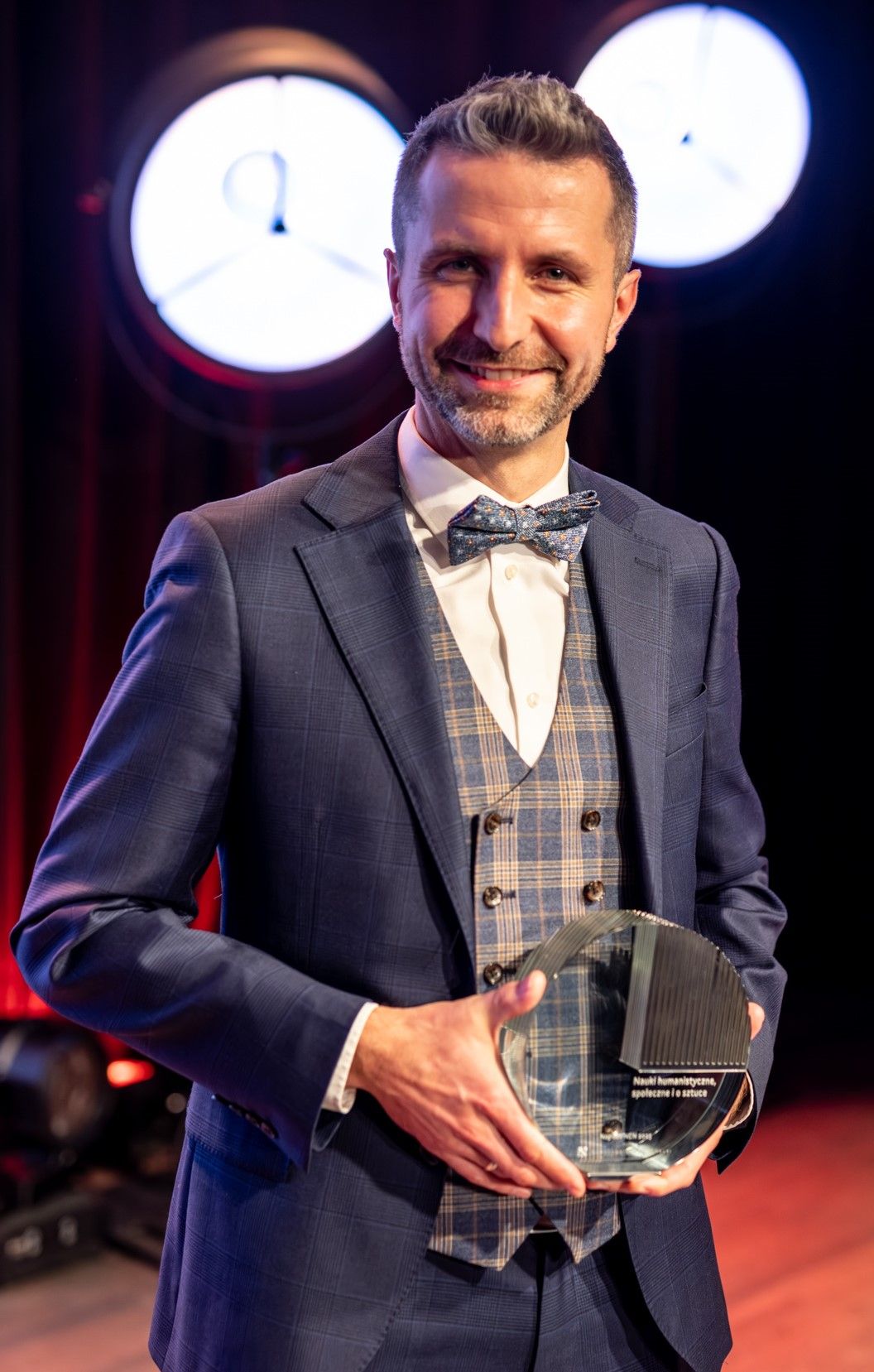 Maciej Stolarski, photo by Łukasz Bera/NCN
Professor Maciej Stolarski from the Faculty of Psychology at the University of Warsaw studies the phenomenon of mental time travel. He has provided empirical evidence for the crucial role of thinking beyond the present moment in shaping the quality and effectiveness of human life. Dr hab. Łucja Kowalewska works at the Faculty of Biology, University of Warsaw. Her research focuses on plant cell biology, particularly on the structure and dynamics of plastid membranes. The research carried out by Dr hab. Bartosz Szyszko, Professor at the University of Wroclaw who specialises in supramolecular chemistry, focuses on the synthesis and investigation of rotaxanes, catenanes and molecular knots – mechanically interlocked molecules that resemble the links of a chain.
Maciej Stolarski, photo by Łukasz Bera/NCN
Professor Maciej Stolarski from the Faculty of Psychology at the University of Warsaw studies the phenomenon of mental time travel. He has provided empirical evidence for the crucial role of thinking beyond the present moment in shaping the quality and effectiveness of human life. Dr hab. Łucja Kowalewska works at the Faculty of Biology, University of Warsaw. Her research focuses on plant cell biology, particularly on the structure and dynamics of plastid membranes. The research carried out by Dr hab. Bartosz Szyszko, Professor at the University of Wroclaw who specialises in supramolecular chemistry, focuses on the synthesis and investigation of rotaxanes, catenanes and molecular knots – mechanically interlocked molecules that resemble the links of a chain.
Last October, they all received the 2025 NCN Award, the most prestigious award in Poland recognising early-career researchers working in Poland. They will soon discuss their research in a series of online lectures organised by the Copernicus Centre.
Lecture by Maciej Stolarski
26 November 2025, 6 p.m.: Psychological Time as Meta-Dimension of Personality: A Theory of Temporal Navigator
The ability for mental time travel allows us to relive the past and anticipate the future. Hence, we can plan and understand our life much better.
‘My lecture will include examples of research and theoretical considerations that enabled me to form the theory of temporal metacognition, develop a model of temporal regulation of emotions and design a new conceptual model – temporal navigator – understanding personality as a cognitive and affective system whose ultimate purpose is to reach (future) goals through mindful or involved presence here and now (the present) using the experience, knowledge and inspirations gathered over a lifetime (past). The model combines knowledge of episodic memory, prospection, emotion regulation and goal-directed motivation, demonstrating that it is not individual contents, but dynamic actions over time that organise human subjectivity and enable effective self-regulation. I will also try to explain how the temporal navigator integrates the concepts of leading personality theories and will talk about how findings from temporal psychology can shed light on the core of psychopathology (the p factor), and whether temporal models might offer a framework for integrating key concepts from positive psychology. Furthermore, I will look into the gaps in existing temporal theories that have kept them from achieving recognition as the psychological ‘theory of everything’, says Maciej Stolarski.
Maciej Stolarski also appeared as a guest in our podcast ‘NextGen Science. The Future is Now’.
The first ‘Science at the Centre’ lectures were delivered by the 2020 NCN Award winners. 15 meetings have been organised so far, together with the Copernicus Centre for Interdisciplinary Studies.