
The first transnational Dioscuri Symposium in Krakow showcased the achievements of the Dioscuri Centres of Scientific Excellence to date, and sparked discussions on the responsibility of science towards society, as well as science communication. The fifth Dioscuri call will be launched in the first half of 2026.
 Dioscuri Symposium
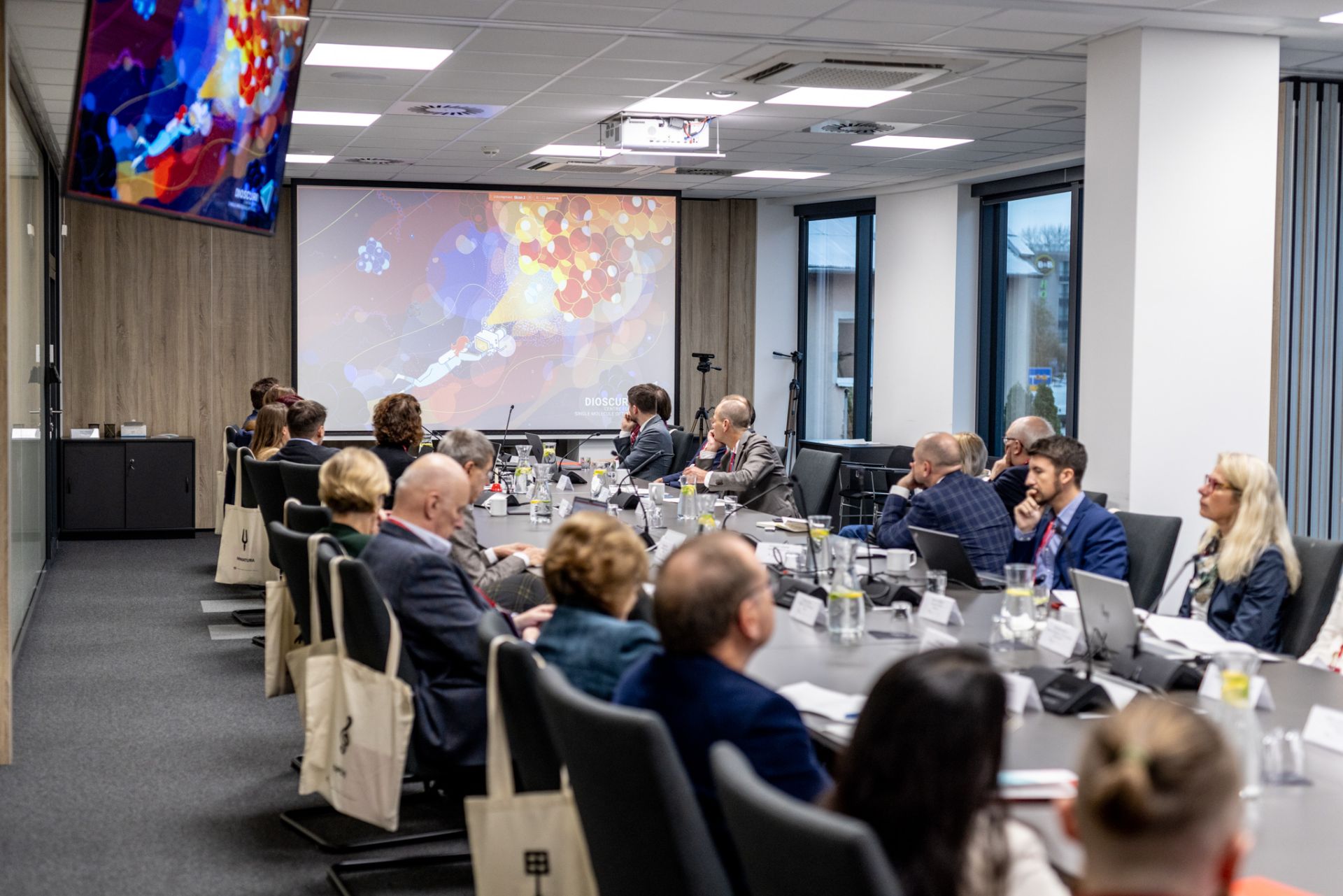
The first transnational Dioscuri Symposium took place at the National Science Centre in Kraków on 3–4 November 2025, bringing together around one table the leaders of the Dioscuri Centres of Scientific Excellence from Poland and the Czech Republic, members of their research teams, administrative coordinators of the Dioscuri Centres, research partners from Germany and representatives of the Scientific Advisory Boards. The discussions were also attended by members of the Dioscuri Committee, chaired by Prof. Joachim Sauer with Vice-Chair Prof. Sir Leszek Borysiewicz, as well as the Director of the National Science Centre Poland (NCN), Prof. Krzysztof Jóźwiak, and the Vice President of the Max Planck Society (MPG), Prof. Christian Doeller. Representatives from the diplomatic sphere, including delegates from the German Ministry of Science and the Ministry of Sport, Culture and Youth of the Czech Republic, followed the deliberations. The research-funding organizations were represented by the Dioscuri Programme Coordinators at NCN and MPG, responsible for the symposium: Dr Małgorzata Jacobs-Kozyra (NCN), who chaired the event together with Dr Agnes Limmer (MPG).
Dioscuri Symposium
The first transnational Dioscuri Symposium took place at the National Science Centre in Kraków on 3–4 November 2025, bringing together around one table the leaders of the Dioscuri Centres of Scientific Excellence from Poland and the Czech Republic, members of their research teams, administrative coordinators of the Dioscuri Centres, research partners from Germany and representatives of the Scientific Advisory Boards. The discussions were also attended by members of the Dioscuri Committee, chaired by Prof. Joachim Sauer with Vice-Chair Prof. Sir Leszek Borysiewicz, as well as the Director of the National Science Centre Poland (NCN), Prof. Krzysztof Jóźwiak, and the Vice President of the Max Planck Society (MPG), Prof. Christian Doeller. Representatives from the diplomatic sphere, including delegates from the German Ministry of Science and the Ministry of Sport, Culture and Youth of the Czech Republic, followed the deliberations. The research-funding organizations were represented by the Dioscuri Programme Coordinators at NCN and MPG, responsible for the symposium: Dr Małgorzata Jacobs-Kozyra (NCN), who chaired the event together with Dr Agnes Limmer (MPG).
Dioscuri – high impact
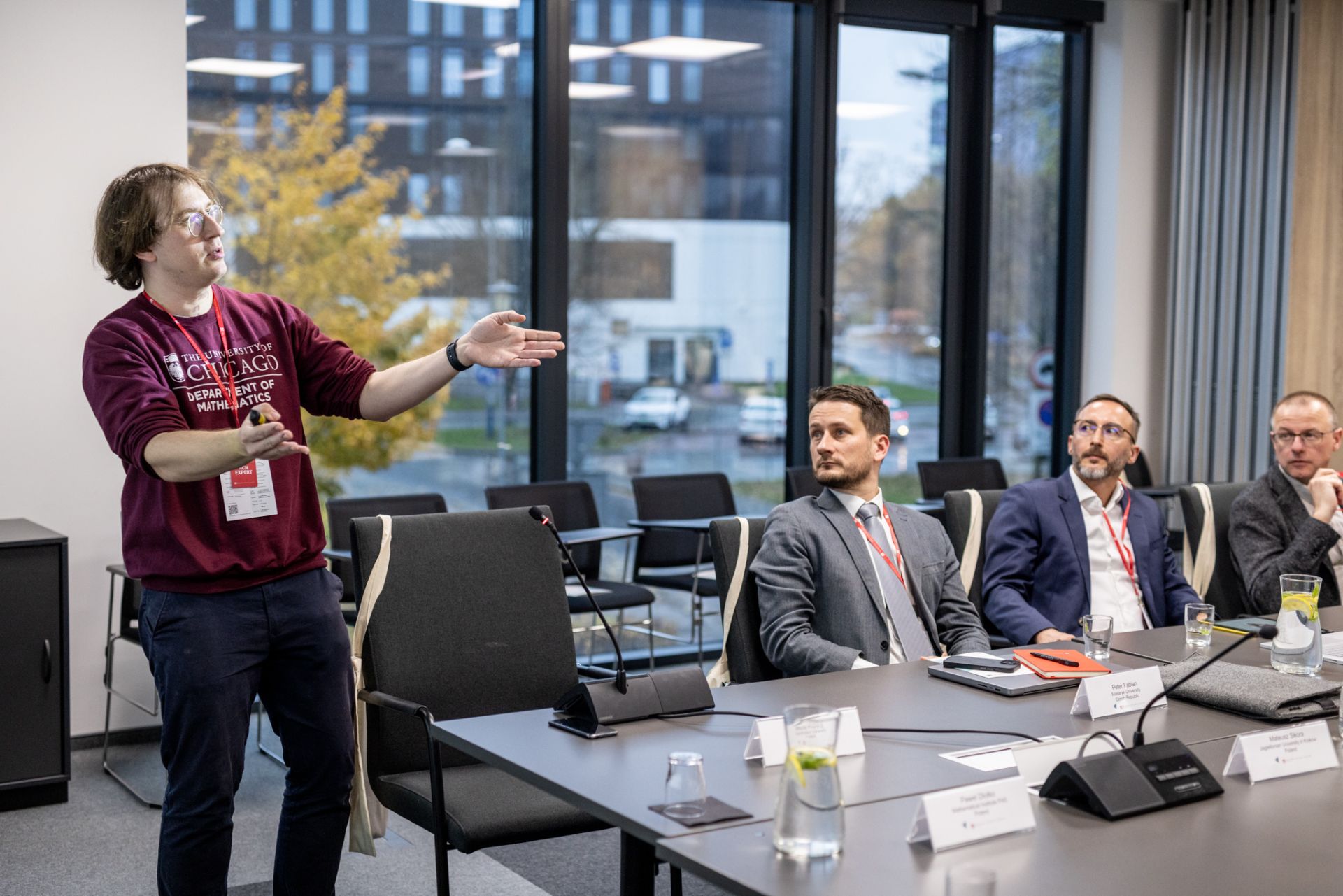 Presentation by Mikołaj Frączyk, Jagiellonian University
The aim of the Dioscuri Symposium was not only to showcase the frontiers of research conducted at the Dioscuri Centres at both PI and early-career levels, but also to address the topic of science communication and to provide targeted training sessions. In a session moderated by Prof. Ulman Lindenberger, the audience heard ten presentations by leaders of the Centres of Scientific Excellence and ten presentations by ECRs, spanning the wide scientific spectrum represented in the Centres - from cell biology and optics to theoretical and applied mathematics. Discussions highlighted the substantial impact of the ongoing research on the development of their respective disciplines, as well as the high-risk, high-gain nature of the projects. Particular attention was drawn to the poster session featuring early-career researchers, who presented their sub-projects and thereby demonstrated the Centres’ broad research scope - further emphasising the autonomy of the Leaders in their supervision and the creation of new leadership in science through the funding of these Centres of Excellence.
Presentation by Mikołaj Frączyk, Jagiellonian University
The aim of the Dioscuri Symposium was not only to showcase the frontiers of research conducted at the Dioscuri Centres at both PI and early-career levels, but also to address the topic of science communication and to provide targeted training sessions. In a session moderated by Prof. Ulman Lindenberger, the audience heard ten presentations by leaders of the Centres of Scientific Excellence and ten presentations by ECRs, spanning the wide scientific spectrum represented in the Centres - from cell biology and optics to theoretical and applied mathematics. Discussions highlighted the substantial impact of the ongoing research on the development of their respective disciplines, as well as the high-risk, high-gain nature of the projects. Particular attention was drawn to the poster session featuring early-career researchers, who presented their sub-projects and thereby demonstrated the Centres’ broad research scope - further emphasising the autonomy of the Leaders in their supervision and the creation of new leadership in science through the funding of these Centres of Excellence.
Science communication in an era of declining trust in science
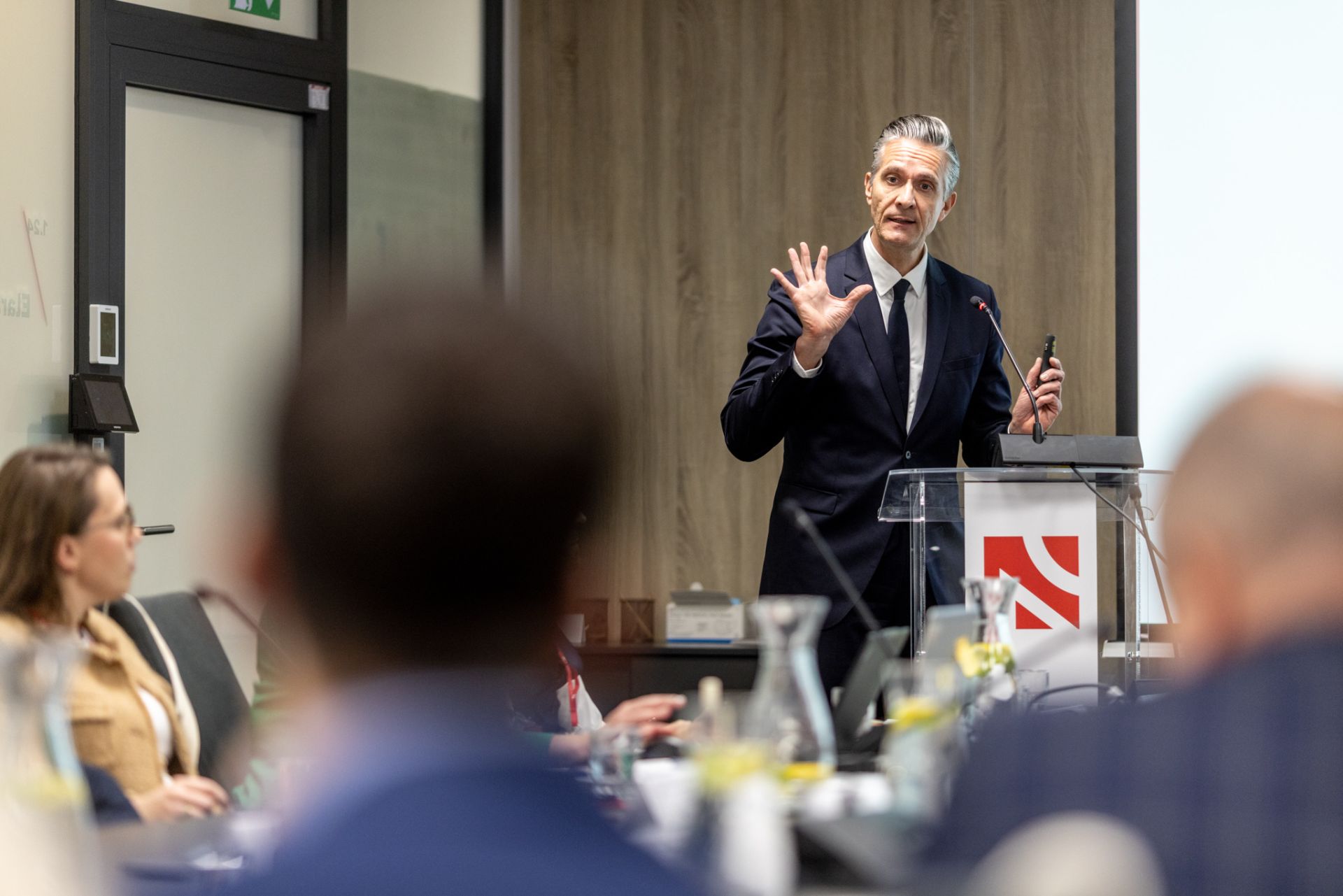 Keynote by Christian Doeller, Max Planck Gesellschaft
Prof. Christian Doeller, Vice President of the Max Planck Society honored the symposium with a keynote speech. He introduced the relevance of science-communication mechanisms not only from the perspective of individual scientists but also from the vantage point of research-performing and research-funding institutions. The keynote highlighted the responsibility of science towards society as a key aspect of science communication. Therefore he advocated for communication channels tailored to specific audiences but also encouraged to proactively seek opportunities for communication. Prof. Doeller illustrated the importance of science communication by showing how scientific work can be framed in relation to current events or societal phenomena.
Keynote by Christian Doeller, Max Planck Gesellschaft
Prof. Christian Doeller, Vice President of the Max Planck Society honored the symposium with a keynote speech. He introduced the relevance of science-communication mechanisms not only from the perspective of individual scientists but also from the vantage point of research-performing and research-funding institutions. The keynote highlighted the responsibility of science towards society as a key aspect of science communication. Therefore he advocated for communication channels tailored to specific audiences but also encouraged to proactively seek opportunities for communication. Prof. Doeller illustrated the importance of science communication by showing how scientific work can be framed in relation to current events or societal phenomena.
His narrative referenced the forthcoming Olympics in Rio de Janeiro: while the scientists’ paper focused on achieving electron-microscopic resolution of the human actomyosin complex, the research news began with Usain Bolt and the question of why he is the fastest person on Earth - explaining that this can be understood by examining the interplay of muscle proteins at such high resolution.
Finally, the keynote addressed the issue of declining public trust in science. He pointed out that the algorithms on social media do not distinguish between serious, fact-based information and misinformation. A study investigated how many climate-change-related videos produced by scientific institutions reach 100,000 views: only two did. By contrast, twenty chemtrail-conspiracy videos reached that threshold. Raising the threshold to one million views removes scientific organisations from the sample entirely - leaving one video by a YouTube influencer and three conspiracy videos. Prof. Doeller clearly stressed the importance of science communication performed by both communication professionals as well as professional scientists to counter this global trend.
Dioscuri as a European success story
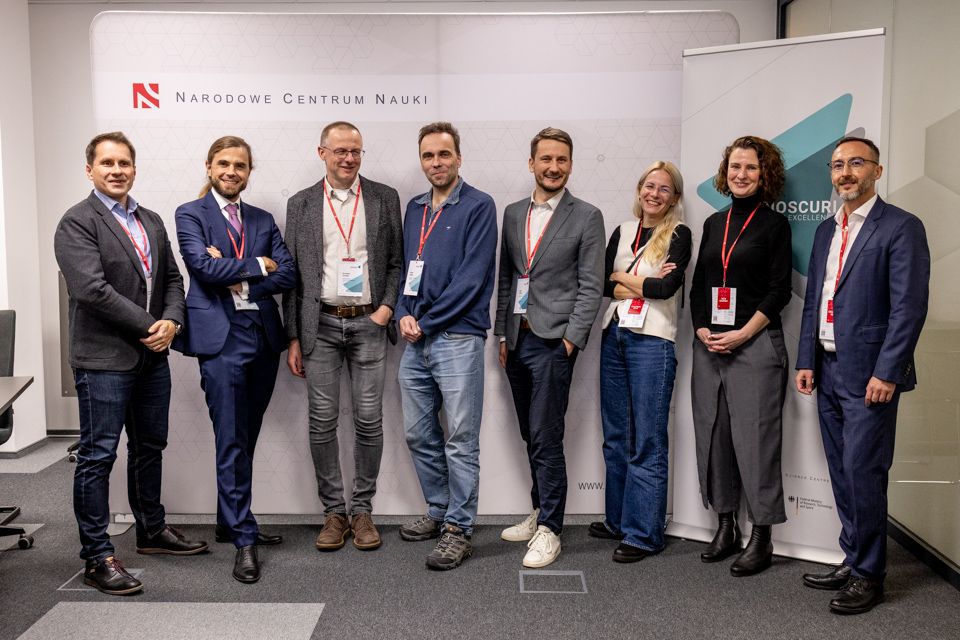 The symposium also provided space for a critical and constructive discussion on the opportunities, challenges and future of the Dioscuri Programme, chaired by Prof. Marta Miączyńska, Head of IIMCB.
The National Science Centre opened this discussion by announcing the upcoming fifth call for proposals for two interdisciplinary Dioscuri Centres of Scientific Excellence in Poland. Prof. Krzysztof Jóźwiak, Director of NCN, together with Prof. Christian Doeller, Vice President of the Max Planck Society, invited the scientific community to apply - emphasising the programme’s openness to all scientific disciplines and its focus on research excellence and interdisciplinarity.
The debate further addressed expectations regarding the Dioscuri Programme from the perspectives of the scientific communities in Poland, Germany and the Czech Republic, as well as the programme’s achievements to date, which could form the basis for a future initiative of this kind.
To round up the Symposium Programme a set of training sessions offered opportunities to acquire new skills: a Planck Academy workshop led by communication professional Rhea Wessel, in which Dioscuri Leaders focused on practical aspects of thought leadership and science communication; a training session delivered by NCN Discipline Coordinators for ECRs, who were introduced to NCN funding opportunities and the principles of the evaluation process; and a meeting led by the Dioscuri Programme Coordinators from Germany, Poland and the Czech Republic, during which administrative coordinators discussed current issues related to the day-to-day operation of the Centres and benefited from an international platform for knowledge exchange.