
“The NCN is the best thing that has happened to the scientific community in free Poland,” says Prof. Jacek Jemielity. Stories of researchers implementing NCN-funded projects clearly illustrate how funding decisions translate into specific research projects and their real-world impact.
Between 2011 and 2024, NCN supported more than 31,000 projects, carried out by over 22,500 researchers. In mid-January, seven of them took part in a meeting with the Sejm Committee on Education and Science — the first such event in the NCN’s history — dedicated to the role of basic research in society and the economy.
"A young PhD graduate will not secure an ERC grant straight away. They first need to learn how to write proposals and navigate the entire process. NCN creates space for this — it allows researchers to start with smaller grants, learn from mistakes, and continue developing. This is essential if early-career researchers are to be able to access larger funds later on, including European, funding,” says Prof. Anna Matysiak.
This influence of the NCN on the career paths of researchers was a recurring theme throughout the discussion, regardless of discipline or career stage.
Research with the potential to transform MS treatment
Dr hab. Aleksandra Rutkowska works at the Medical University of Gdańsk, where she leads a team investigating multiple sclerosis — a central nervous system disease that most commonly affects young women at the peak of their professional and family lives. In multiple sclerosis, the immune system attacks the myelin sheaths surrounding neurons, disrupting the transmission of nerve signals. "Myelin sheaths work like insulation on electrical wiring: once it is lost, electrical impulses escape and information fails to reach its target,” explains the researcher. This mechanism is responsible for symptoms such as visual impairment, sensory disturbances, and mobility problems.
Her research addresses two critical areas: neuroinflammation, understood as the processes that allow immune cells to penetrate the brain, and remyelination, namely the regeneration of damaged myelin sheaths. While current therapies are effective at suppressing inflammation, they do not repair damage that has already occurred. The team’s objective is to develop treatments that not only stop disease progression but also actively promote regeneration within the nervous system.
The result is a novel therapeutic strategy that has recently been granted a Polish patent and is now undergoing the European patent procedure. Supported by robust in vitro and in vivo data, the project has been recognised by an international investment fund as scientifically mature and ready for further development.
“A basic research project fully funded by NCN is moving straight into the implementation phase,” says Aleksandra Rutkowska. “A foreign investor intends to finance further preclinical research as well as the first phase of clinical trials, including trials involving patients with multiple sclerosis.”
After more than 11 years of research work in Ireland and Switzerland, she returned to Poland thanks to the POLONEZ call. The grant allowed her to establish an independent research group and pursue research with full scientific autonomy.
As she stresses, the opportunity to focus exclusively on research — without teaching responsibilities or hierarchical constraints — remains rare in Poland and would not have been possible without NCN support. The researcher actively engages in initiatives supporting women in science and the popularisation of research. Her profile has also been featured in UNESCO’s virtual science museum — as the only Polish woman included alongside Maria Skłodowska-Curie.
Stories of recovery and loss
Karolina Ćwiek-Rogalska is a professor at the Institute of Slavic Studies of the Polish Academy of Sciences. Her work explores how new communities and cultures emerged in Central Europe after 1945. She focuses in particular on regions shaped by post-war resettlements — places where millions of people found themselves living in unfamiliar environments, deeply marked by the presence of previous inhabitants. “1945 was not a year zero,” she emphasises. “It marked the beginning of a long process in which new bonds, meanings, and ways of living were forged in spaces inherited from others.”
Through ethnographic and archival research, she examines how people lived among the “remnants of former cultures”: in houses, towns, and landscapes never designed for them. Her work asks how people made sense of what they encountered and how long it took to come to terms with this material and symbolic inheritance. Estimates suggest that post-war resettlements affected as many as one in four people in Poland — yet many of these experiences were never told.
The research also has a social dimension. It provided the basis for a new exhibition at the Wałcz Land Museum (Muzeum Ziemi Wałeckiej) — the first in forty years — which recounts the city's history through individual stories, rather than abstract narratives. Ćwiek-Rogalska also regularly delivers open lectures and participates in public debates on how the experience of the so-called Recovered Territories should be discussed today, and why — even 80 years after the war — we still lack a language to describe these processes.
The outcome of many years of research is the book titled Ziemie: historie odzyskiwania i utraty, published at the end of 2024. The book has already gone through additional print runs and attracted interest beyond Poland, including in German, Dutch, and English-language media.
"I have received roughly as many NCN grants as I have experienced failures,” the researcher notes. Her first support came through a small MINIATURA grant focusing on the former Koszalin Regency. She now heads the OPUS grant, examining how post-war bureaucracies in Poland and Czechoslovakia attempted to ‘manufacture’ a sense of national belonging — often quite literally on the reverse sides of German administrative forms and documents.
Experience gained within the national grant scheme also paved the way for international success. In 2022, she was awarded the ERC grant Recycling the German Ghosts, implemented by a Polish–Czech–Slovak research team. The project investigates how material traces left by former inhabitants are reintroduced into social circulation and how their meanings evolve over time.
In 2023, she received the NCN Award for outstanding research achievements by early-career researchers.
“The work of a humanities scholar is not about sitting alone with a piece of paper,” she stresses. “It is long-term fieldwork, teamwork, learning to understand local perspectives, and resisting ready-made answers. Because the less we know about one another, the easier it becomes to manipulate us.”
Cell therapies in orthopaedics and cardiology
One of the participants in the meeting with parliamentarians was Prof. Ewa Zuba-Surma. “It was a very constructive and substantive meeting. I hope there will be more such events, and that they will lead to a deeper understanding of, and stronger support for, research in Poland,” she says.
Ewa Zuba-Surma carries out her research at the Department of Molecular Virology at the Faculty of Biochemistry, Biophysics and Biotechnology of the Jagiellonian University. After returning from a fellowship in the United States several years ago, she established her own research group thanks to return grants from the Foundation for Polish Science. For the team’s continued operation and rapid development, funding from the National Science Centre proved decisive. “NCN support enabled us to introduce new methods, train early-stage researchers abroad, and move beyond basic research towards applied research projects. It also allowed us to compete confidently in European funding calls as an equal partner within international consortia,” she notes.
The team led by Zuba-Surma focuses on exploiting the unique properties of stem cells and the bioactive derivatives they release to support the repair of damaged tissues. The research focuses on the development of next-generation cellular and biological therapies, as well as tissue engineering solutions such as implants and organoids. These approaches have potential applications in medicine — particularly in orthopaedics and cardiology — and also in veterinary practice.
The team collaborates closely with research institutions and business partners in Poland, across Europe, and in the United States. One concrete result of this work is the advanced therapy medicinal product — MezoSela Ortho. Designed for patients with degenerative joint disease (osteoarthritis), the therapy has already successfully completed phase I and phase II clinical trials. Technologies developed by the Kraków-based team have also gained international recognition, as demonstrated by their recent presentation to investors in Silicon Valley.
A short path to application
Prof. Jacek Jemielity heads a biological chemistry laboratory at the Centre for New Technologies at the University of Warsaw. For over 25 years, his research has focused on mRNA technologies — molecules that act as the cell’s “instruction manual” for producing proteins. His team develops mRNA modifications that enhance both stability and therapeutic efficacy. This technology formed the basis for the first COVID-19 vaccines and is now being applied in areas such as cancer vaccines, therapies for rare genetic disorders, cell therapies, and in combination with CRISPR-Cas technology.
Research carried out by Prof. Jemielity moves swiftly from the basic stage to real-world applications. The team has co-authored more than a dozen patents and patent applications, several of which have already been commercialised. Two solutions developed at the University of Warsaw have been licensed to BioNTech and are currently being used in more than a dozen clinical trials, mainly in the field of personalised cancer vaccines.
“I am fortunate to work in a field where the path from knowledge to application is very short," says Prof. Jacek Jemielity. “Basic research allows us to test whether an idea truly makes sense before it reaches patients.”
Experience in technology transfer also led to the creation of ExploRNA Therapeutics, a spin-off company of the University of Warsaw. The company conducts research into RNA therapies and employs several dozen specialists. It has also secured private funding and a grant from the Bill and Melinda Gates Foundation. At the same time, the researcher heads the Centre for New Technologies at the University of Warsaw. In his view, institutions such as NCN play a fundamental role in the wider ecosystem of science and innovation.
“The NCN is the best thing that has happened to the scientific community in free Poland,” he emphasises. “Without strong basic research, there can be no meaningful innovation. If we want to harvest results, we must first sow good seed.”
Processes that shape the future
Demography tells a story about the future of societies: how many people there will be, at what age and in what health they will enter the decades ahead, and which public decisions will truly matter.
Anna Matysiak, Professor at the Faculty of Economic Sciences of the University of Warsaw and head of the Interdisciplinary Centre for Labour Market and Family Dynamics LabFam, works with a team examining three core processes shaping population structures: fertility, mortality, and migration. Research at LabFam focuses, among other topics, on declining birth rates across Europe, social inequalities in both the length and quality of life, and the role of migration in ageing societies. These are questions with no easy answers — and no patents waiting at the finish line.
“This research will not lead to patents. No commercial partner will be interested in it. Yet its social and economic importance is immense, because it directly affects how societies and economies function,” she says.
As Matysiak points out, such research is highly relevant socially and economically, but difficult to finance in schemes geared towards rapid implementation and easily measurable outputs. This makes stable funding for basic research essential. It allows research teams to grow, young researchers to be trained, and the competencies to be developed that are necessary to access larger funds, including European ones.
The researcher, after many years of academic work in Germany and Austria, returned to Poland following the award of a grant from the European Research Council in 2019. She also transferred the ERC project, originally written in Austria, to the University of Warsaw under the “Polish Returns” programme of the Polish National Agency for Academic Exchange.
Today, LabFam runs international projects, cooperates with public institutions in Poland and abroad, and attracts researchers from other countries. The team brings together researchers at different stages of their careers — including those gaining their first experience of grant funding within the national research funding scheme.
“Basic research is extremely difficult to fund from other sources in Poland,” she stresses. And without stable funding, it is impossible to build teams, educate young people, and develop the knowledge that the state needs in the long term.”
Anna Matysiak is the winner of the first edition of the NCN Award (2013) and the Prize of the Foundation for Polish Science (2025). At the end of 2024, we published an interview with the researcher as part of our #rozmowaNCN series, entitled I can do more over here.
Nanofibres — from tissue regeneration to smart uniforms
Prof. Urszula Stachewicz returned to Poland after 11 years of academic work abroad — in Germany, the Netherlands, and the United Kingdom. Funding from NCN allowed her to build an international research team, establish a laboratory from scratch at the AGH University of Science and Technology in Kraków, and ultimately secure a grant from the European Research Council.
Her research specialisation is electrospinning — a technique that enables the production of extremely fine fibres, up to a thousand times thinner than a human hair. “At first glance, these materials resemble a tissue paper, but in fact they consist of around 90 percent air,” she explains, pointing to their unique porosity.
The team's research focuses on understanding the electrospinning process itself and how the surface and mechanical properties of nanofibres affect cellular behaviour. “Cells integrate very well with our structures, which allows us to accelerate healing and deliver active substances precisely to damaged tissues,” Stachewicz explains. Based on this research, the team has developed, among other applications, dressings for patients with atopic dermatitis that support tissue regeneration and improve comfort.
Their work extends well beyond medical applications. The large specific surface area of nanofibres enables the investigation of their potential for capturing water from the air, including from fog, as well as for generating energy from motion through piezoelectric and triboelectric effects.
The unique properties of nanofibres also pave the way for the production of smart textiles. These solutions have attracted the attention of the defence sector, particularly in the context of designing technologically advanced military uniforms and clothing for firefighters. As the researcher emphasises, all such applications originate in basic research on material properties.
The team's findings are published in leading journals in the field of materials engineering, including on the covers of the most prestigious titles, and some of the solutions are protected by patents.
Last year, the researcher was also featured in our #rozmowaNCN series.
Macromolecules for technology and medicine
“I completed my PhD as a co-investigator in an NCN-funded project. This allowed me to gain real scientific skills,” said Prof. Róża Szweda during the meeting.
This experience paved the way for her subsequent academic career abroad. She spent several years working in France, including at a prestigious research centre where, as she emphasises, Nobel Prize winners were working at the time. Eventually, readiness for independence emerged, followed by a decision to return to Poland. “It was not sentimentality, but a clear-headed comparison of what France offers and what Poland offers. NCN gave me a genuine opportunity to launch my own research,” she explains.
Her first NCN project after returning allowed her to build a research team and begin work on an original scientific concept. "This research gave me both the toolkit and the first preliminary results on which I could continue to build,” she says. This work became the foundation for securing a Starting Grant from the European Research Council, awarded in 2023.
Róża Szweda is a Professor at the Adam Mickiewicz University in Poznań, where she specialises in macromolecular chemistry. Within the ERC SHAPE project, she develops research on synthetic polymers designed to replicate functions known from living systems. Proteins serve as the key point of reference — macromolecules whose properties stem from precisely encoded sequences. Her team applies this principle of sequence control to synthetic polymers, unrelated to biology, designing molecules that can fold into specific structures and perform programmed functions.
The research also extends into practical applications. The team works on selective catalysis and chemical processes designed in accordance with the principles of green chemistry — energy-efficient, carried out at room temperature, and free from harmful by-products. At the same time, future-facing technologies are being explored, including molecular data storage and materials inspired by the functioning of biological systems.
As the researcher emphasises, the role of the NCN goes far beyond funding individual projects. “It is also about building a CV, international visibility, and the ability to act as an equal partner in European projects,” she says. “This means that even at a relatively early stage of my career, I can participate in bodies that genuinely shape the directions of research development in Europe."
The stories presented here are — as the researchers themselves note — only the visible part of a much bigger picture. With stable funding, the potential of Polish science can drive progress for us all.
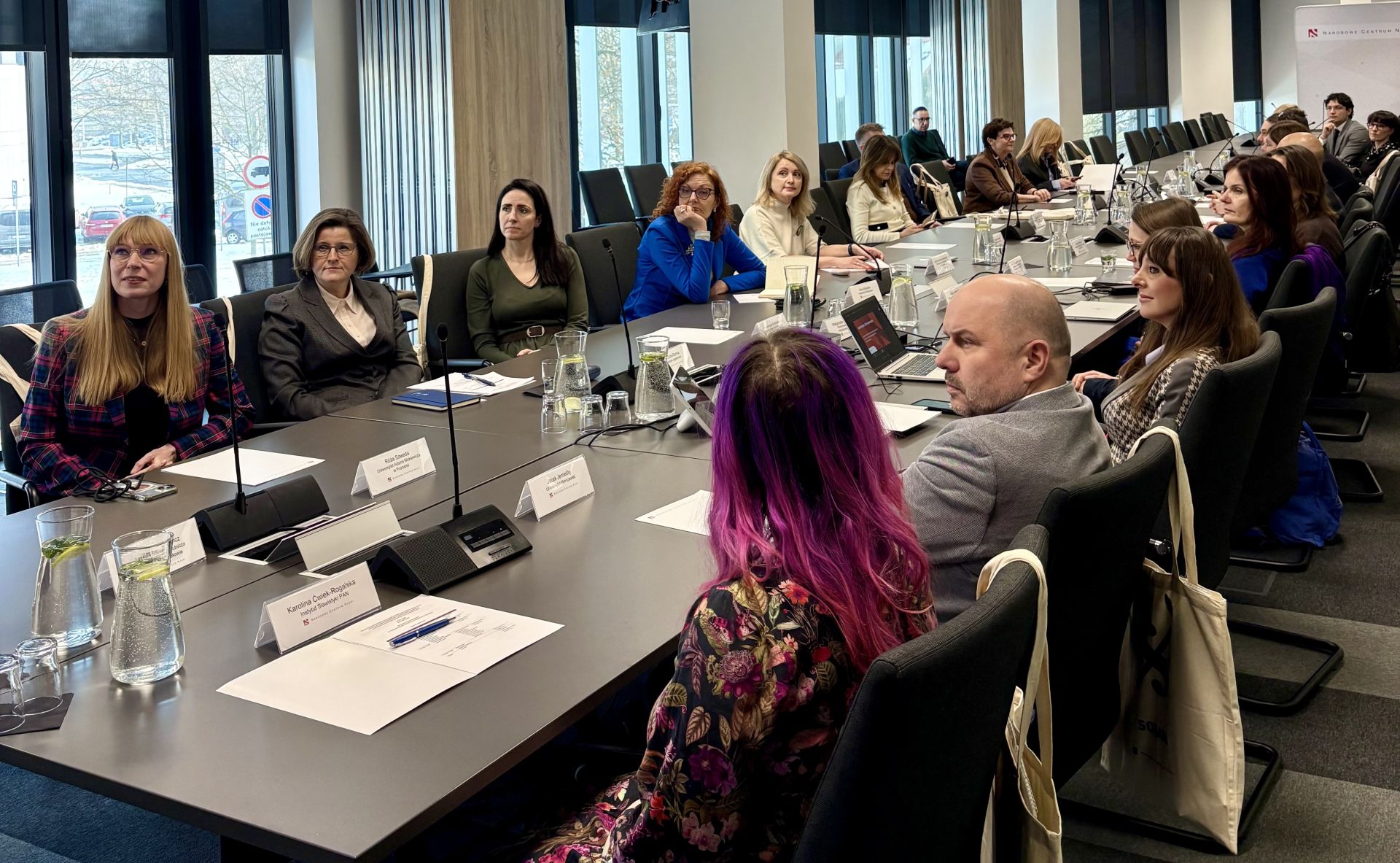
Participants of the meeting with the Parliamentary Committee on Education and Science