
Piotr Achinger, Dawid Kobiałka and Paweł Sikorski are the winners of this year’s NCN Award. This most prestigious distinction for early-career researchers was presented at the Wawel Castle on 14 October.
The awarded researchers work in Warsaw and Łódź. Piotr Achinger is a Professor at the Institute of Mathematics, Polish Academy of Sciences, the biologist Paweł Sikorski is a Professor at the University of Warsaw, and the archaeologist Dr Dawid Kobiałka is based at the University of Lodz.
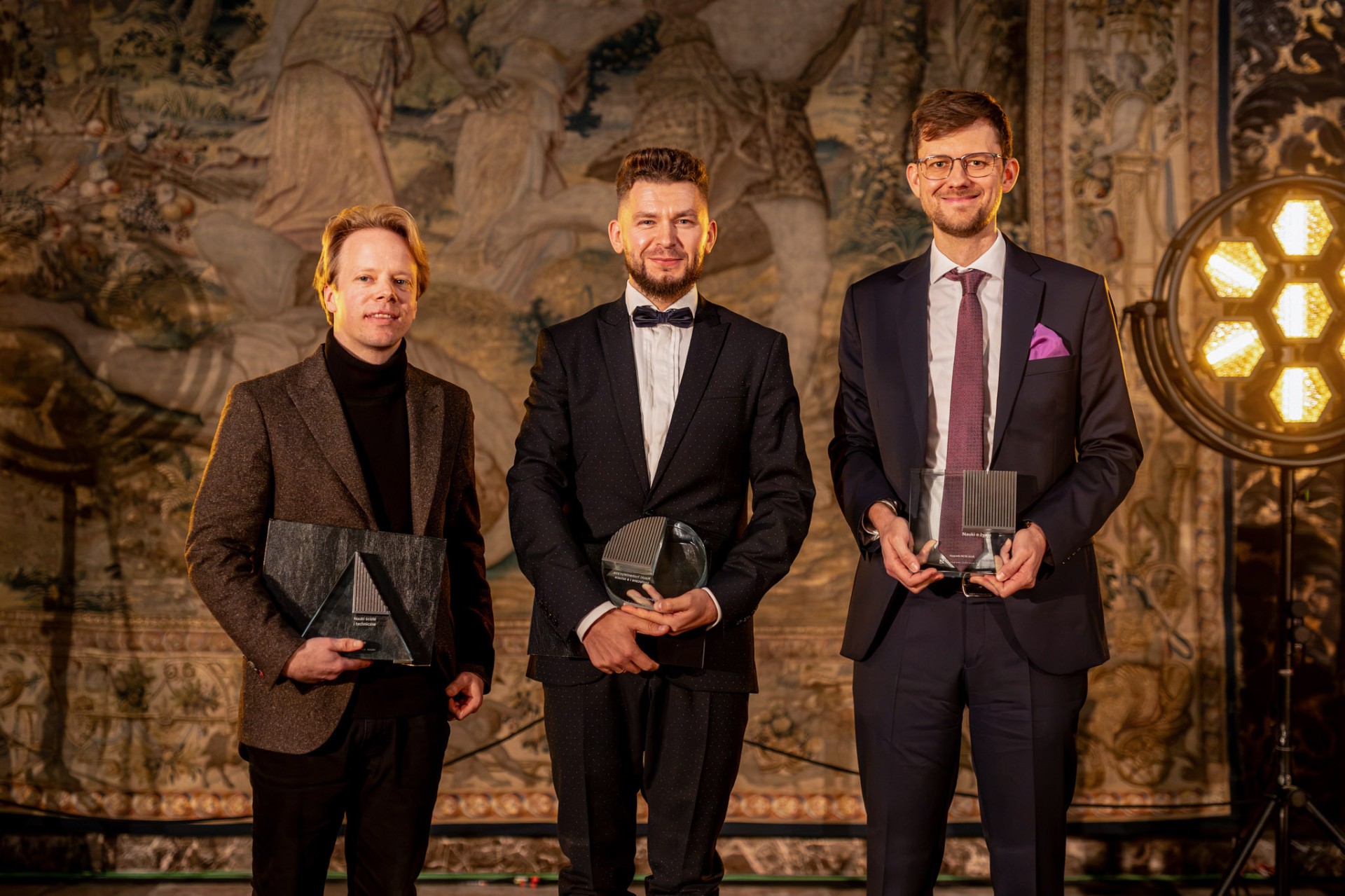
Fourteenth NCN Award and first ceremony at Wawel Castle
Since 2013, the NCN Award has been presented to researchers whose work pushes the boundaries of knowledge and makes a significant contribution to the world of science, in recognition of their outstanding basic research projects conducted at Polish research institutions. The winners are selected in three categories: Humanities, Social Sciences and Art Sciences (HS), Physical Sciences and Engineering (ST) and Life Sciences (NZ). This year, for the first time, the Award ceremony was held at the Wawel Castle, marking the fourteenth presentation of the award, and highlighting the celebrations of NCN’s fifteenth anniversary.
Tying strings in the realm of pure algebra
Piotr Achinger specialises in algebraic geometry. He received the NCN Award for his ground-braking research of algebraic varieties over fields of positive characteristic and non-Archimedean fields.
“My field of mathematics reveals surprising connections between seemingly unrelated areas, such as algebra and topology, or number theory and mathematical physics. I seek to describe the shapes of algebraic varieties and their surprising connections with number theory. Fundamental groups lie at the heart of my work. These mathematical objects describe how strings can be tied together in a given space. This is a challenging task because in the realm of pure algebra, strings do not exist, and the spaces we study often resemble clouds of cosmic dust,” he says.
Piotr Achinger has authored a series of eight papers that address classical problems in geometry in a new and more challenging setting. He has demonstrated that a broad class of geometrical objects has a surprisingly simple structure. Before, little was known about the structure of even very simple objects of this kind. His research refers to the so-called mirror symmetry and explores concepts studied by the Fields Medal Winners Peter Scholze and Pierre Deligne.
His research findings were published in leading research papers and attracted attention of the world’s most distinguished mathematicians. His award nomination provided that “the methods employed in his papers skilfully combine technical algebraic and topological concepts with deep geometrical insight.” Piotr Achinger emphasises that “the purpose of mathematics is not merely to produce theorems but to foster human understanding.”
Since 2025, Piotr Achinger has worked in Warsaw and at the same time at a newly established Department of Mathematics at Kyiv School of Economics.
He was conferred his PhD at the University of California, Berkley, and he earned his habilitation from the Institute of Mathematics, Polish Academy of Sciences. He completed a post-doctoral fellowship at Institut des Hautes Études Scientifiques in France. On numerous occasions, he conducted research at renowned academic institutions in Austria, Germany, United States, Japan and Australia. He has also carried out research project funded by the National Science Centre and by the European Research Council.
New way of documenting difficult heritage
Dawid Kobiałka was awarded for his interdisciplinary archaeological studies of World War II mass-murder sites. His research studies include forensic archaeology, archaeology of crime, archaeology of the recent past and contemporary armed conflicts, as well as heritage studies, and public and community archaeology.
He is originally from Chojnice. As a child, he spent a lot of time with his friends at the site he now studies. During the war, it was called the Death Valley. “This site is a landscape of terror, where mass executions were conducted during World War II. Three decades later, I returned to the site as a doctoral researcher together with a group of researchers, volunteers, civic activists and IPN prosecutors, to locate the victims’ remains. The research enabled us to locate the remains of almost 700 victims, 700 Polish citizens, our parents, grandparents and great grandparents,” he says.
Archaeological research conducted in the Death Valley by Dawid Kobiałka’s team contributed to the location of mass graves of victims of crimes committed in 1939 and 1945.
In autumn of 1939, the victims of mass murders in the Gdańsk Pomerania region included people with mental illnesses. Most of their graves were burnt in 1944 during the so-called Aktion 1005. The grave discovered near Chojnice in 2024 was the only one that remained intact.
In January 1945, more than one hundred Polish prisoners were murdered by the Germans. The recovery of their remains in 2021 was the first such excavation in Poland conducted in accordance with archaeological standards. Some victims were identified.
Dawid Kobiałka’s international research team also studied other places. More remains were found in the Szpęgawski Forest and by the Lake Borówno. In total, the team found, documented and studied the remains of more than one thousand victims of the World War II murders.
The researchers also studied the Lamsdorf camp (Łambinowice), where 60 Italian prisoners died between 1943 and 1944. They were all identified by name. The researchers managed to reach some of their descendants and, at the request of some of them, the remains were transported to Italy.
Dawid Kobiałka’s research has social implications and allows to fully describe the history of land where mass murders were committed during the war and acknowledge the victims who have so far remained in the shadow of Auschwitz. Conversations with witnesses and residents of sites of mass murder combine archaeology with contemporary studies. “We develop the idea of archaeology of mass murders as a multidimensional, multilevel interdisciplinary approach which aims to offer a new way of addressing and documenting the difficult heritage of the World War II. This research has a social, cultural and humanitarian dimension. It is a mission we wish to pursue in the future,” he says.
Dawid Kobiałka’s research is funded by, among others, the National Science Centre and the Ministry of Culture and National Heritage. Dawid Kobiałka was conferred his PhD in archaeology at the Adam Mickiewicz University in Poznań. He also worked at the Institute of Archaeology and Ethnology, Polish Academy of Sciences. As part of his PhD studies, he received a scholarship from the Swedish Institute at the Linnaeus University in Kalmar.
Understanding RNA’s unique language
Paweł Sikorski received the NCN Award for his research into how cells recognise double-stranded RNA (dsRNA) and convert the signal into a precise biological response.
“RNA has been with me through my scientific career. In my research, I try to understand how cells recognise RNA and respond to it. In our laboratory, we study how cellular response is impacted by various features of RNA, such as structure, length, or chemical modifications. We are particularly interested in double-stranded RNA which can be generated during viral infections but can also be produced in our cells. What is important, cells do not respond to each such RNA in the same way. They can recognise RNA features and, on this basis, activate various immune responses. Hence, I try to understand RNA’s unique language and determine which molecular features dictate how cells respond to RNA,” he says.
Double-stranded RNA alarms cells by activating the innate immune system which is the body’s first line of defence. This response must be carefully regulated, as an overactive immune response can damage cells and contribute to the development of autoimmune diseases. Paweł Sikorski demonstrated that a cellular response depends on certain features of RNA molecules, such as their length, end structures, and chemical modifications. Components of the response can be activated independent of each other. For example, the inflammatory signal may be independent of the inhibition of protein production or RNA degradation. Paweł Sikorski also demonstrated that chemical modifications affect cellular RNA recognition and the activation of the immune response.
His research has potential practical application. RNA properties, such as stability, translation efficiency, and the ability to trigger an immune response, can be precisely controlled. This opens up the possibility of designing RNA molecules with predefined biological and therapeutical parameters. “The knowledge gained through our research not only enhances our understanding of the fundamental mechanisms of cell biology, but also enables us to design RNA-based therapeutics more deliberately,” he underlines.
“What fascinates me most about science is the moment when experimental results make us look at a problem differently than we initially anticipated, when the most interesting questions arise,” he says.
Paweł Sikorski is a professor at the Faculty of Biology at the University of Warsaw and head of the research group of the Laboratory of Epitranscriptomics at the Biological and Chemical Research Centre, University of Warsaw. In 2024, he received the Prime Minister’s Award for his research achievements, which formed the basis for his habilitation. He is a part of the NCN Generation comprising researchers whose careers were launched with NCN grant funding. He carried out his first research project before earning his PhD, and has led five NCN-funded research projects so far.
The Wawel Castle was the partner of this year’s NCN Award ceremony.
The 2026 NCN Award was held under the patronage of Science in Poland. In November and December, the Award winners will deliver a series of lectures for the general public, which will be streamed as part of the Science in the Centre series on the Copernicus Center channel.
NCN Award Ceremony Partner:
Media patronage
