
This year, the National Science Centre will celebrate its 15th anniversary. As usual, we will continue our hard work to support Polish researchers. We also wish to share the impact of basic research on the social, economic and national development.
“Our priority remains stable, transparent and competitive research funding across disciplines under call for proposals,” says Prof. Krzysztof Jóźwiak, NCN Director. “The current level of grant funding does not reflect the state potential or the needs of the Polish researchers. Therefore, we will strive for increased funding to make sure that ambitious projects can be pursued in decent conditions. Starting in 2026, we plan to issue bonds,” he adds.
Our plans for the nearest future also include continued efforts to promote further internationalisation of Polish science by enhanced cooperation with Polish and foreign partners, increased involvement in activities aimed to implement NCN-funded project results and to support open science.
 Domestic and International Calls
We are planning to launch eight calls in 2026 from our domestic call portfolio. We will launch two OPUS calls addressed to all researchers, one in spring and one in autumn. The latter call will follow the Lead Agency Procedure under the Weave programme, whereby Polish research teams can cooperate with teams from Austria, Czechia, Slovenia, Germany, Switzerland, Luxembourg or Belgium-Flanders. We are also planning to launch PRELUDIUM, SONATINA, SONATA, SONATA BIS, and MAESTRO calls addressed to researchers at various stages of their research career. In February, we will launch the 10th edition of our flagship MINIATURA call for research activities. Call Portfolio. What can be funded? Check our previously funded projects (examples).
The beginning of a new year is a great opportunity to launch the 4th edition of the EEA and Norway Grants, with the NCN continuing to act as the operator of the “Basic Research” programme. We will fund fundamental research, in particular in the area of Humanities, Social Sciences and Art Sciences, subject to the key priorities of the 4th edition of the EEA and Norway Grants: Green Transformation of Europe; Democracy, Rule of Law, and Human Rights; and Social Inclusion and Resilience). We will launch two major calls: GRIEG BIS and (interdisciplinary) LANGSPIL and two supporting Coordination & Capacity calls, and will pursue the SPARK programme.
In 2026, we will also strive to enhance international collaboration and work towards creating new opportunities for collaboration between Polish and foreign researchers. We are now accepting proposals to two calls: OH-TREAT and LEAP-SE Cofund Call 2026. We are also planning to launch 6 other international calls in cooperation with research-funding agencies and academic and science institutions in the framework of international programmes and partnerships. New call editions involving cooperation with M-ERA.NET, T-AP, Biodiversa+ and OHAMR, will be organised alongside new initiatives, such as LUKE (Linking Ukraine to the European Research Area), a platform for cooperation and knowledge exchange, aimed to integrate Ukrainian and European researchers to strengthen the Ukrainian R&I ecosystem, and a call organised in cooperation with the European Partnership for Resilient Cultural Heritage, which the NCN entered as a partner. The ongoing cooperation with the Max Planck Association will enable us to launch the 5th Dioscuri call, whereby two new Centres of Scientific Excellence will be established in Poland to conduct interdisciplinary research. The ongoing Weave-UNISONO call, conducted in accordance with the Lead Agency Procedure, will remain open for submissions throughout the year. We will continue coordination of the QuantERA network, and CHANSE and POLONEZ BIS programmes, as well as the European partnerships EOSC, Biodiversa+ and OHAMR at national level. Preparations for launching the STR partnership will continue. Upon formation, the partnership will fund international research projects addressing major societal challenges.
Strengthening Polish Research Potential: Collaboration Between Polish and Foreign Institutions
 Our mission includes collaboration with other state agencies and science institutions. We collaborate with the National Centre for Research and Development (NCBR) to enhance the technological readiness of basic research results. In order to encourage foreign researchers to conduct research in Polish research institutions, we cooperate with the Polish National Agency for Academic Exchange (NAWA) in securing funding for research components under the Polish Returns Programme and, since 2026, a new TOP200 NAWA programme aimed at supporting transnational science cooperation. We support the Medical Research Agency (ABM) in calls for basic research projects in medical and health sciences.
In 2026, we will continue our involvement in the ERC Mentoring Initiative allowing prospective ERC applicants to use mentoring support. Due to ongoing collaboration with the Polish-American Fulbright Commission, researchers returning to Poland after completing their fellowship in the USA will be offered financial support to continue their research in Poland.
As an institution, the NCN will remain an active member of Science Europe, giving an even stronger voice to Polish researchers owing to Director Krzysztof Jóźwiak’s appointment to the Science Europe Governing Board last November.
We have supported open science for many years and have been involved in the formation of the European Open Science Cloud (EOSC), aimed to create an open trusted virtual multi-disciplinary international environment where researchers can store, share, process and reuse digital objects used in research. We are the National Mandated Organisation in the EOSC Association. Our 2026 activities will include the EOSC cooperation under the 10th Framework Programme and continued participation in the build-up phase of development of the EOSC Federation.
Where To Meet Us?
The 10th NCN Days will be organised in Katowice. As usual, the event will include meetings, panel discussions, workshops for applicants, workshops on administrative and financial support for NCN-funded projects, and workshops on research data management. Throughout the year, we will also offer meetings and workshops online.
Celebrate the NCN’s 15th Anniversary with us! Have you received an NCN grant that enabled you to pursue independent research, supported your scientific discovery, contributed to the development of an alternative therapy or development of new functional materials, or perhaps otherwise impacted your career in research? Share your story! Tag your social media post with #PokolenieNCN or write to us.
You can listen to our podcasts on our YouTube channel (now also available in video format) where we discuss issues important to Poland and Polish research.
What Was 2025 Like?
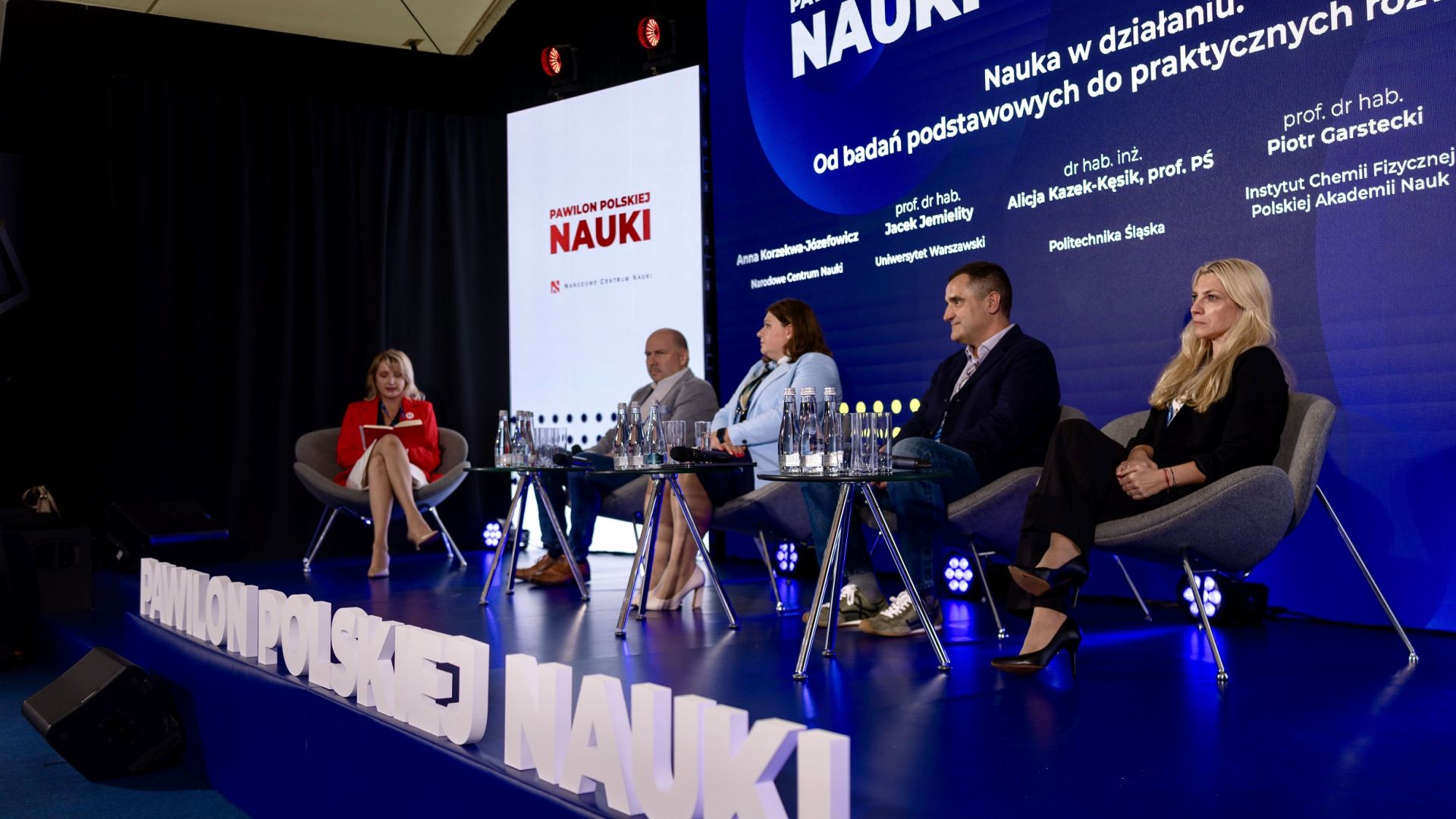 Panel discussion: Science in action, Economic Forum in Karpacz
Panel discussion: Science in Action; Economic Forum in Karpacz. Last year, we discussed the importance of basic research for the development of innovation and of the state. The government has considered research one of Poland’s development priorities. An extra PLN 500 million received at the end of 2024 in the form of bonds enabled us to gradually increase our call budgets, which is still not enough to meet Poland’s development needs and sufficiently reinforce the Polish scientific community. In view of the draft 2026 budget bill which keeps the NCN’s grant for research at its current level, last September, the NCN Council requested that NCN funding be increased by PLN 400 million.
Panel discussion: Science in action, Economic Forum in Karpacz
Panel discussion: Science in Action; Economic Forum in Karpacz. Last year, we discussed the importance of basic research for the development of innovation and of the state. The government has considered research one of Poland’s development priorities. An extra PLN 500 million received at the end of 2024 in the form of bonds enabled us to gradually increase our call budgets, which is still not enough to meet Poland’s development needs and sufficiently reinforce the Polish scientific community. In view of the draft 2026 budget bill which keeps the NCN’s grant for research at its current level, last September, the NCN Council requested that NCN funding be increased by PLN 400 million.
Regardless of the budget issues, we managed to accomplish our mission. We launched 8 domestic calls and 7 international calls in collaboration with research funding agencies and institutions worldwide. We completed 9 domestic calls, awarding over 1.3 thousand grants for research projects and research components, and over 600 grants for research activities. We published the results of 7 international calls, funding 71 projects with Polish participation. In 2025, we awarded a total funding of over PLN 1.9 billion to researchers working in Poland. Database of Project Funded by the NCN.
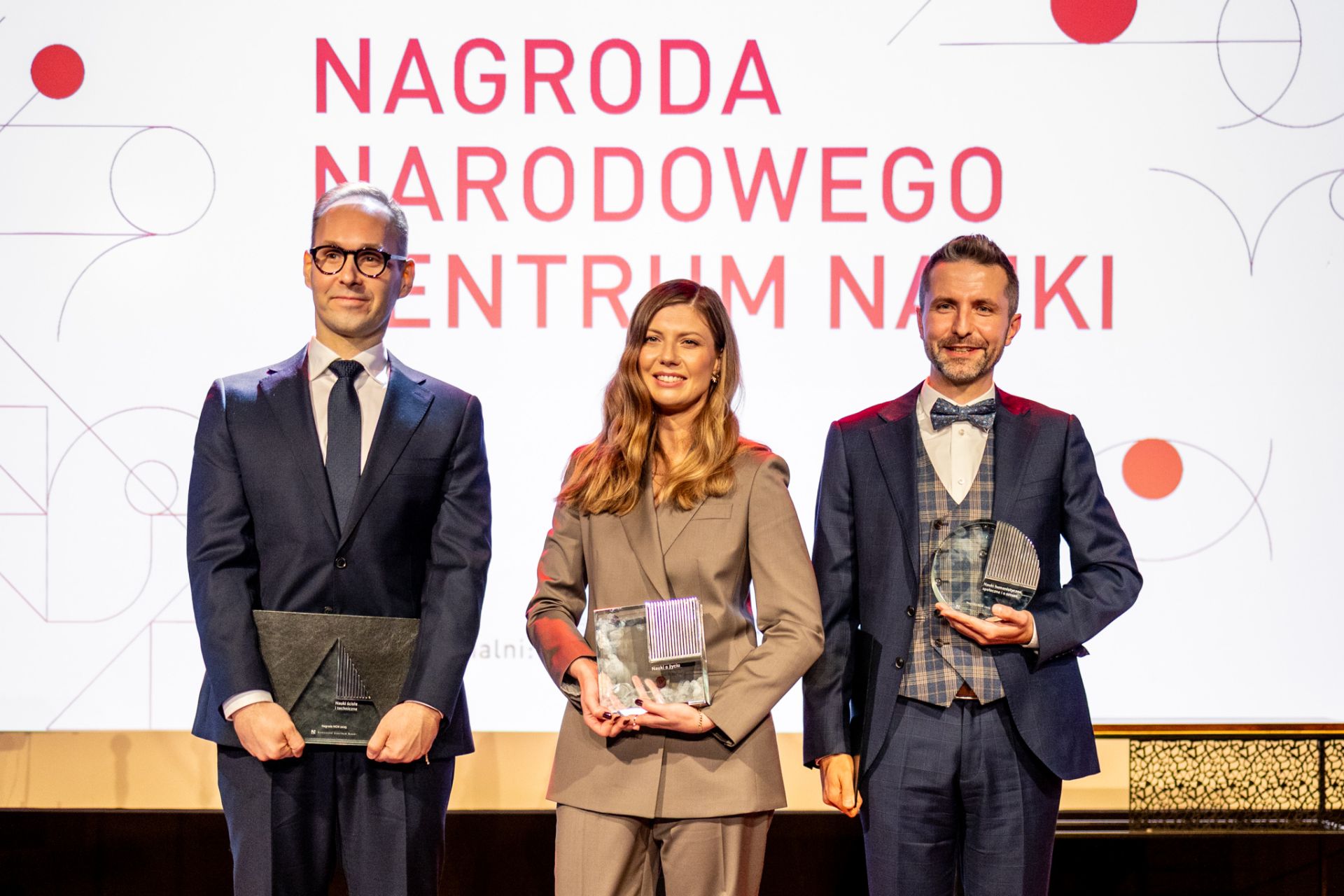 2025 NCN Award Winners
For the thirteenth time, the NCN Award was presented to outstanding early-career researchers. This time, the award went to Bartosz Szyszko, Łucja Kowalewska, and Maciej Stolarski.
2025 NCN Award Winners
For the thirteenth time, the NCN Award was presented to outstanding early-career researchers. This time, the award went to Bartosz Szyszko, Łucja Kowalewska, and Maciej Stolarski.
Over the year, in consultations with the scientific community, we modified the implementation procedure of NCN-funded projects. We no longer require that research results be published in open access, although we still strongly advocate for open access: open science is more transparent and is of greater benefit to society. The NCN Council issued the recommendations to disseminate research results, e.g., to publish in journals where papers are published by experts in the field, and to avoid publishing in the so-called predatory journals.
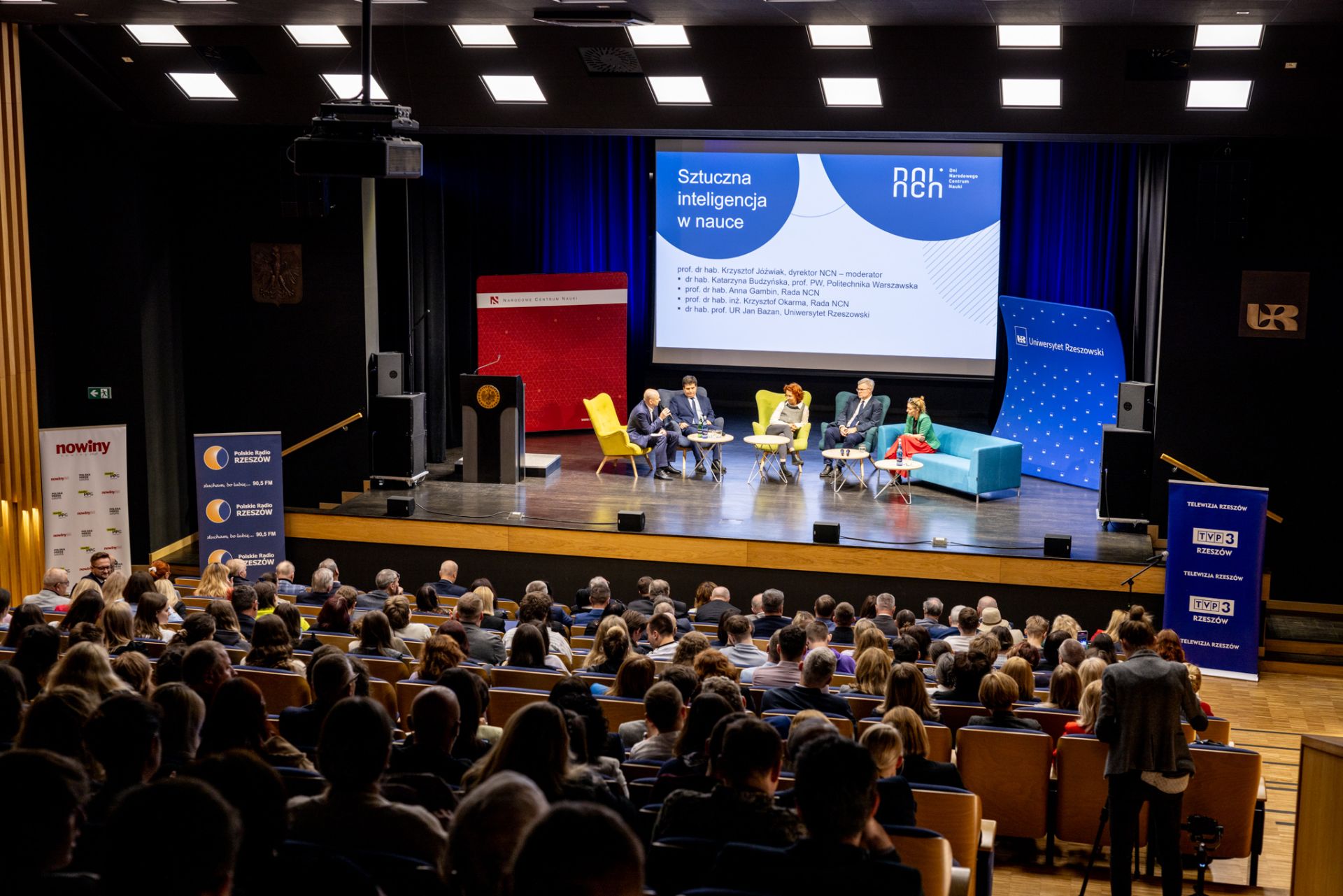 NCN Days in Rzeszów
We advocated for further funding opportunities for Polish researchers. Apart from resuming the role of coordinator in the Basic Research programme under the 4th Edition of EEA and Norway Grants, we agreed upon the terms of the 5th call for the Dioscuri Centres of Scientific Excellence, together with the German Max Planck Association. We also joined two European partnerships: One Health Antimicrobial Resistance (OHAMR) and Resilient Cultural Heritage.
NCN Days in Rzeszów
We advocated for further funding opportunities for Polish researchers. Apart from resuming the role of coordinator in the Basic Research programme under the 4th Edition of EEA and Norway Grants, we agreed upon the terms of the 5th call for the Dioscuri Centres of Scientific Excellence, together with the German Max Planck Association. We also joined two European partnerships: One Health Antimicrobial Resistance (OHAMR) and Resilient Cultural Heritage.
In 2025, we organised the NCN Days in Rzeszów. We were also present at numerous conferences, seminars, workshops and online courses. Until 2026, then!